What It Is Like to Have Aphantasia and No Inner Monologue
When I close my eyes there is no image, and when I think there is no voice. What is left is not emptiness. It is feeling, concepts, and a strong sense of direction.
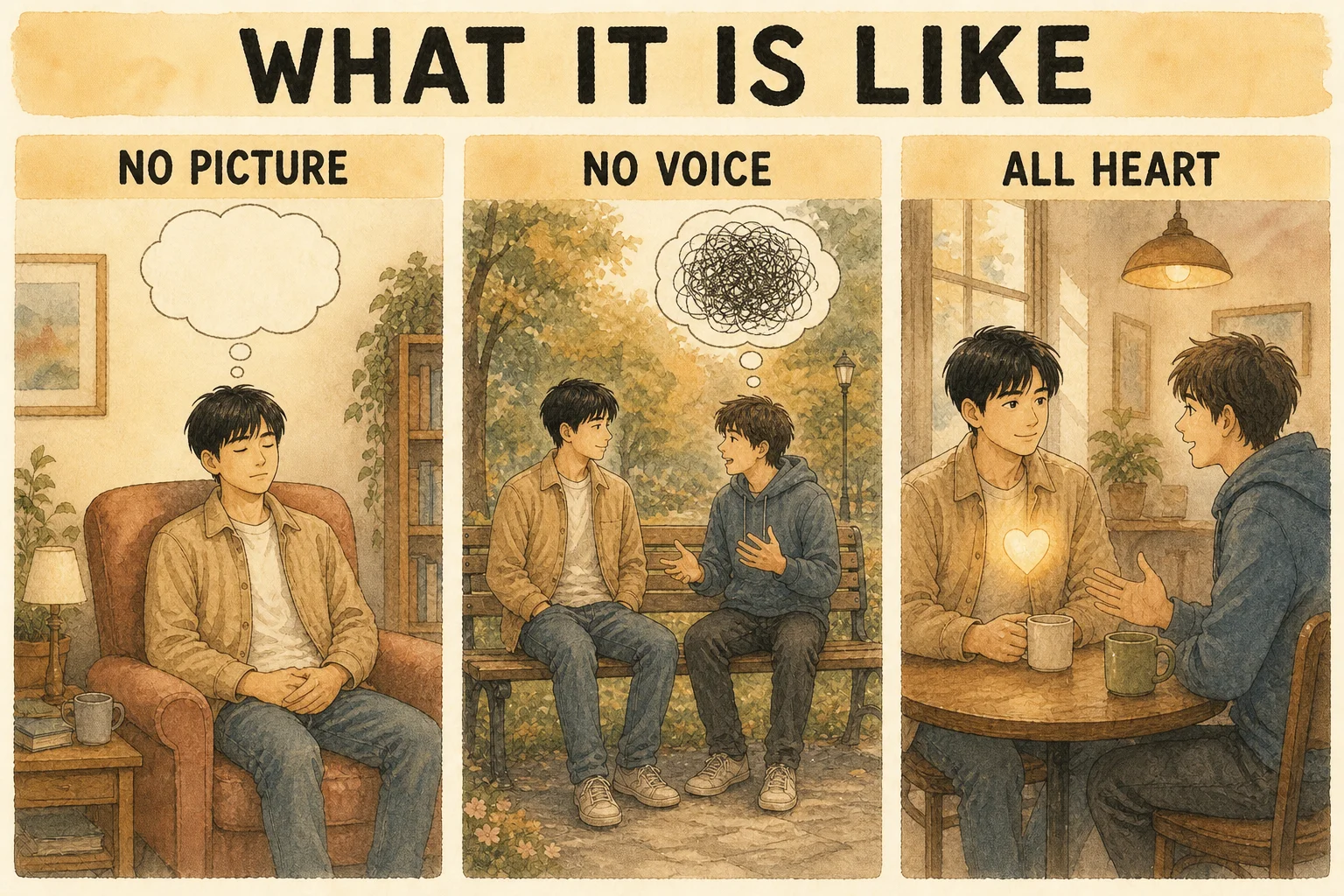
How I actually think
People sometimes ask, reasonably, "Then what is going on in there?"
Abstract ideas show up easily. Connections show up easily. I can take in a huge amount of information in a short time and see the pattern in it. What does not show up is a picture of anything, or a sentence spoken by a voice.
When I think of a person, I do not see their face. I feel them. When I think of a concept like authenticity, I do not see a scene or hear a definition. I feel what authenticity is. If you gave me a better word for that feeling I would happily switch, because the word was never the point. The feeling was.
The closest description I have found: I move less toward an image of the future and more along a direction, like an inner compass. I do not think in stories as much as I think in systems and how they change. I am a heart-driven person, and I think aphantasia is part of why.
No voice in my head
I also do not have an inner monologue. Many people hear a running commentary through their day, sometimes several voices that disagree with each other. I do not.
Not everyone with aphantasia is like this. Plenty of people have no mind's eye and a very talkative inner voice. For me the two go together, and I think the combination explains a lot about how quickly I move on (see Moving On) and how present I can be with the person in front of me. There is no second conversation happening in my head while you are talking.
What comes easily
- Letting go. I move on from the past quickly and get over a bad mood quickly.
- Forgiving. I cannot replay a hurtful thing someone said unless I deliberately go looking for it.
- Changing. I cannot picture myself, so I do not get stuck in a fixed image of who I am. I can grow fast.
- Big-picture thinking. Without detail crowding in, I think naturally in abstractions, principles, and long time horizons.
- Not being self-conscious. There is no voice narrating how I look to others.
- Quitting things cold turkey. I cannot picture the thing I gave up, so there is very little craving pulling me back.
- Advertising slides off me. A lot of persuasion works by planting an image. There is nowhere for the image to land.
- Listening. I am an auditory learner, and hours of talks and conversations energize me.
- Eating the same meal again. I cannot relive a meal, so the tenth time tastes almost as good as the first.
What I build systems for
It is not all gift, and I want to be honest about that.
- Names, dates, addresses, and phone numbers. I do not hold them. They come back more easily once I am deep in conversation.
- Small details. What someone wore, what my apartment looks like, where things were in a room.
- Memories. I cannot relive my past the way many people can. My memory of my own life is thin.
- Anticipation. I do not look forward to a vacation the way other people do, because I cannot picture it.
- Memorizing. I cannot memorize a speech. If I know something by heart, it is because I have internalized it deeply.
- Visual overload. Images and video tire me out much faster than audio does.
So I write everything down. When a thought arrives, I capture it right away, because it may be gone forever if I do not. It is part of why I am a prolific writer. I keep my calendar religiously, because otherwise I would have no idea what I am doing next week. And I document the people and places I love, because documentation is a memory I can go back to. More on that in Hyper-Documenting.
Why I love AI image tools
Of course I love AI art generation. It feels like being handed a part of my brain that seems to be missing. I can describe something I feel and, for the first time, see it outside of myself.
Further Reading
- How I Found Out
- Moving On
- Hyper-Documenting
- Faith Without Pictures
- The Spectrum: where I sit among the variants.