Where the Word Came From
Aphantasia is an old human experience with a new name. The word was proposed in 2015, which means most people who have it grew up with no way to describe it.
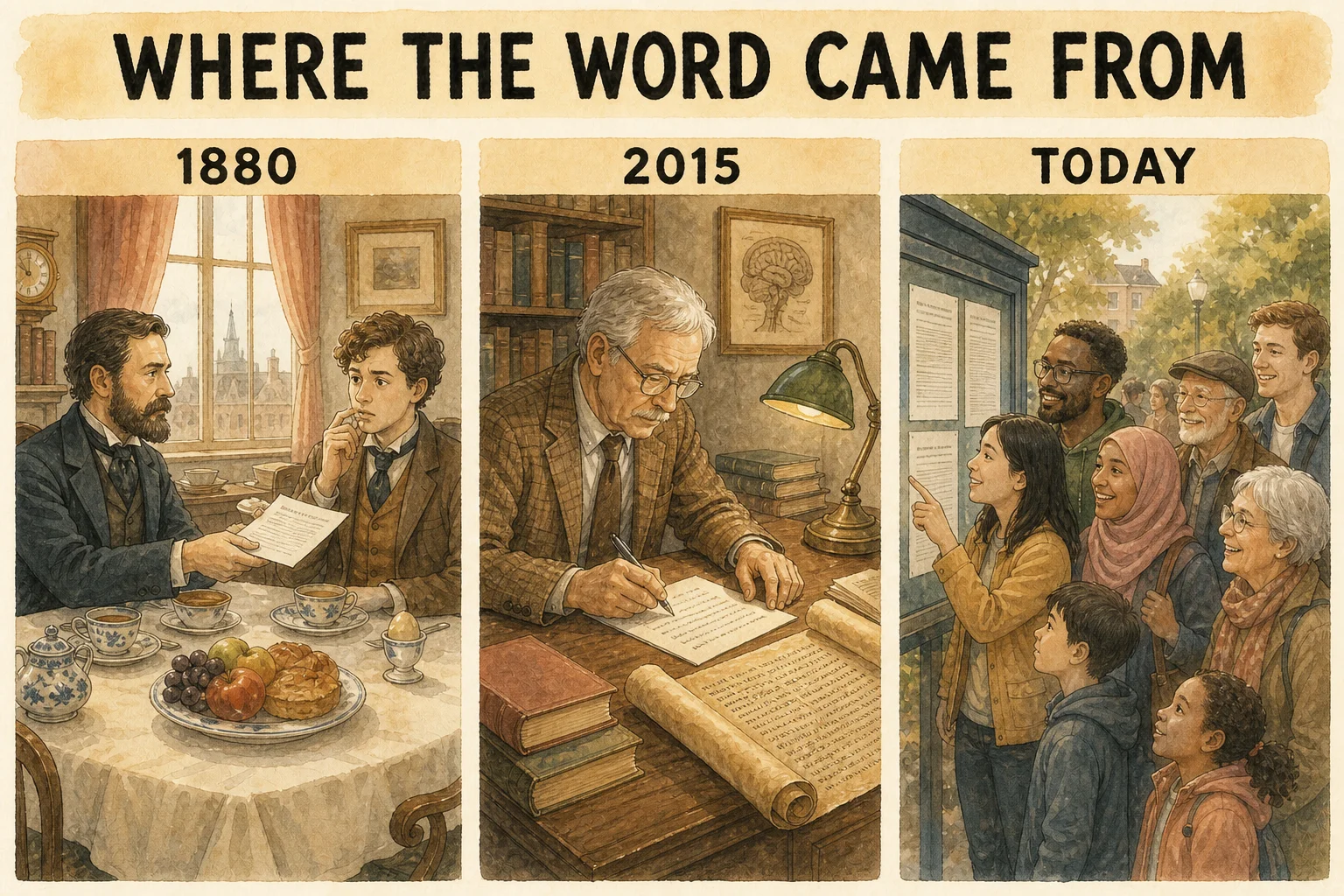
1880: the breakfast table
The story starts with the Victorian scientist Francis Galton. In 1880 he asked people to "think of some definite object, suppose it is your breakfast-table as you sat down to it this morning" and describe the picture that rose before the mind's eye: how bright, how sharp, how colorful. Most people described a picture. Some said they had no idea what he meant, because for them there was no picture at all. (Galton, "Statistics of Mental Imagery," Mind, 1880)
Then, for more than a century, the question mostly sat on the shelf.
1973: measuring vividness
In 1973 the psychologist David Marks published the Vividness of Visual Imagery Questionnaire, the VVIQ. It asks you to imagine sixteen scenes and rate each one from "no image at all" to "perfectly clear and as vivid as normal vision." It is still the standard self-report test today. (Marks, 1973)
2010: the man who lost his mind's eye
In 2010, the neurologist Adam Zeman and colleagues described a patient known as MX, who suddenly lost his visual imagery after a minor medical procedure. Remarkably, MX still did well on tests that seemed to require imagery. Brain scans showed he was solving them a different way. (Zeman et al., Neuropsychologia, 2010)
After a magazine wrote about MX, people started writing to Zeman to say, in effect: that is me, except I was born this way.
2015: giving it a name
In 2015 Zeman, Michaela Dewar, and Sergio Della Sala published a short paper in the journal Cortex describing 21 of those people. They proposed a name, borrowing from Aristotle:
"φαντασία, phantasia, is the classical Greek term for imagination... We propose the use of the term 'aphantasia' to refer to a condition of reduced or absent voluntary imagery."
A- means without. Phantasia means imagination, the power by which an image is presented to the mind. Aphantasia: a mind without pictures. (Zeman, Dewar & Della Sala, "Lives without imagery," Cortex, 2015)
Two details from that first paper stand out. Most of the 21 people still saw images in their dreams. And many reported strengths in verbal, mathematical, and logical thinking.
2016 and after: the world finds out
In April 2016, Blake Ross, a co-creator of the Firefox web browser, posted an essay on Facebook called "Aphantasia: How It Feels To Be Blind In Your Mind." It spread widely. Countless people read it and realized for the first time that "picture this" was not a figure of speech. (Refinery29 coverage, 2016)
Since then the research has grown quickly. A few findings worth knowing:
- How common it is. In a 2022 study of about 1,000 people, 0.8% had no visual imagery at all, and 3.9% had none or only dim imagery. (Dance, Ipser & Simner, 2022) The University of Exeter puts it at around 1 in 100. (Exeter, 2024)
- The other end exists too. About 3% of people have hyperphantasia, imagery as vivid as real seeing. (Exeter, 2024)
- Careers. In a study of about 2,000 people with little or no imagery, over 20% worked in science, computing, or mathematics. People with hyperphantasia leaned toward the arts. (Exeter, 2020)
- Scary stories. When people with aphantasia read a frightening story, their skin-conductance response stayed flat. Frightening images affected them like everyone else. Imagination seems to be part of how a story scares us. (Wicken, Keogh & Pearson, 2021)
- Spatial reasoning is intact. People with aphantasia generally do fine on spatial tasks. The picture is missing, not the understanding of space. (Keogh & Pearson, 2018, summarized here)
Zeman himself has described aphantasia as "an intriguing variation in human experience, not a disorder." (BBC Science Focus)
Why the newness matters
If you have aphantasia and you are over about 25, you grew up in a world with no word for your mind. You probably assumed everyone was like you, or that you were just bad at imagining. That is why finding the word so often brings relief: an old experience finally has a name you can understand yourself by.
Further Reading
- The Spectrum: the variants and neighbors of aphantasia.
- People With Aphantasia
- How I Found Out
- You Are Not Broken