An Ode to Neurodiversity
Our differences are our gifts. No two minds were made the same, and none of them was made by mistake.
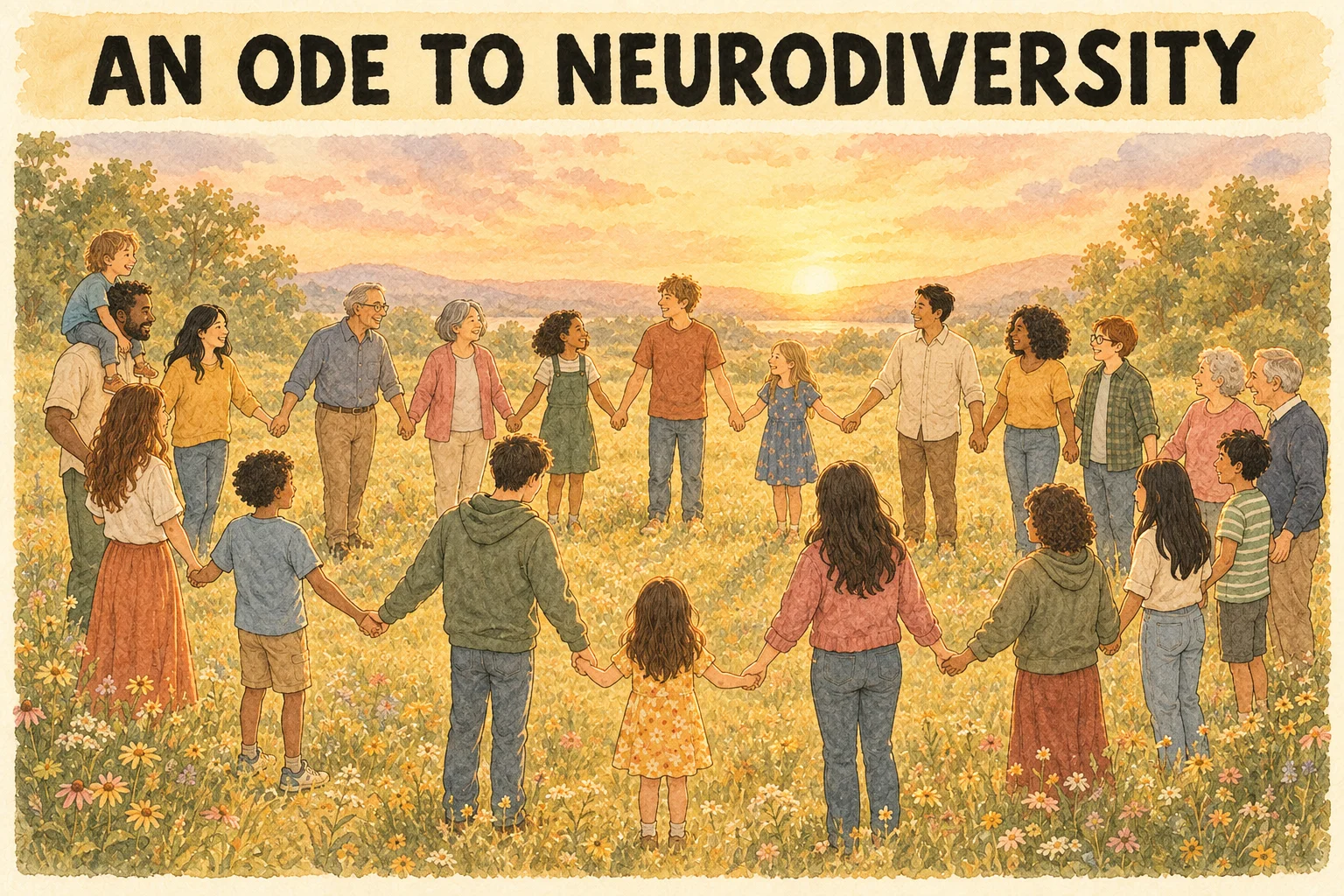
The factory we grew up in
Most of us grew up in a world that did not value how differently minds work. We were taught in the same way, tested in the same way, and ranked on the same scale. If you did not fit the standard, it was easy to feel like a defective product coming off the line.
I felt that way for a long time. I could not memorize formulas the way other people could. I struggled to learn foreign languages. I felt misunderstood, and I did not have the words for why.
Then I found out I have aphantasia and no inner monologue, and the first thing I felt was relief. I was not broken. I was different, and now I could say how.
How wide the range really is
After that I started asking everyone how their minds work, and I learned how wildly different people are. Some see vivid pictures. Some see nothing. Some hear a constant voice, some hear several, some hear none. Some can relive a memory with smell and taste. Some barely remember their own childhood. Some think in words, some in pictures, some in feelings, some in systems.
A person's intelligence, their worth, and the difference they can make in the world cannot be measured on one sliding scale. There are too many dimensions.
One body, many parts
The Apostle Paul wrote about this almost two thousand years ago:
"If the whole body were an eye, where were the hearing? If the whole were hearing, where were the smelling? But now hath God set the members every one of them in the body, as it hath pleased him." (1 Corinthians 12:17-18)
I believe the differences in our minds are part of that design. The person who sees everything in pictures needs the person who feels their way. The person with a strong memory needs the person who moves on quickly. The one with a loud inner voice needs the one who is simply present. God did not make one kind of mind and then a lot of faulty copies. He made many kinds, on purpose, so that we would need each other.
The world I hope for
I want a world where people see each other's differences as strengths. Where couples, families, friends, and teams understand how each other's minds work, and communicate, relate, and collaborate lovingly because of it. Where a kid who cannot see pictures in her head grows up hearing that she is fearfully and wonderfully made, not that something is missing.
We live in a remarkable time for this. Aphantasia was only named in 2015. Science is only now catching up to how varied we are, and tools like voice transcription and AI image generation give minds like mine abilities they never had. It is one of the best possible times to find out who you are. (More in Hyper-Documenting.)